
Storytelling vs. Selling: How Wineries Can Market Without Sounding Like Everyone Else
Storytelling is a marketing buzzword, but what Do Wineries Really Need to Know About it?
Storytelling has been reduced to a marketing buzzword — a superficial one-liner in marketing blogs. But the underlying craft of storytelling isn’t new, nor is it a trend to be discovered. It’s also not some novel marketing technique that just started. Stories have moved people since long before anyone was selling anything (and long before today’s marketing bloggers started posting about it on LinkedIn). The wineries that actually benefit from storytelling aren't the ones that add a marketing narrative created by an agency, they're the ones that truly understand what a story structurally requires. A good story needs a real subject, genuine tension, and specifics that can't be swapped onto a competitor's marketing. Anything short of that isn't storytelling, it's marketing fluff dressed up as storytelling.
What Storytelling Really is (and what it’s definitely not)
Somehow in the last little while, "storytelling" stopped meaning a craft and started becoming a marketing flavour-of-the-month. Companies started posting jobs for “Storytellers.” Marketing decks recommend it. Agencies pitch storytelling as if it were some cool new tactic. A lot of business "About" pages now start with some version of "our story began..."
Why is this a problem?
A sentence that starts with "our story" and then lists a founding year, a location, a brief founder’s bio and a passion for winemaking isn't a story. It's a biography with narrative language painted on top. There’s research that backs up why this story distinction matters: Stanford research found engaging stories to be roughly 22 times more memorable than facts presented alone. However, that only works when something is actually functioning as a story, not facts labeled as one.
Once Upon a Vine
Real storytelling didn't arrive with content marketing. It's the oldest form of human communication there is (and yes, long before anyone was optimizing for marketing engagement). People have been using narrative to pass down what mattered since the dawn of time, because narrative is how human memory is actually built. Walt Disney, for example, was a master of storytelling a hundred years ago. Marketing didn't invent this, it just started borrowing it.
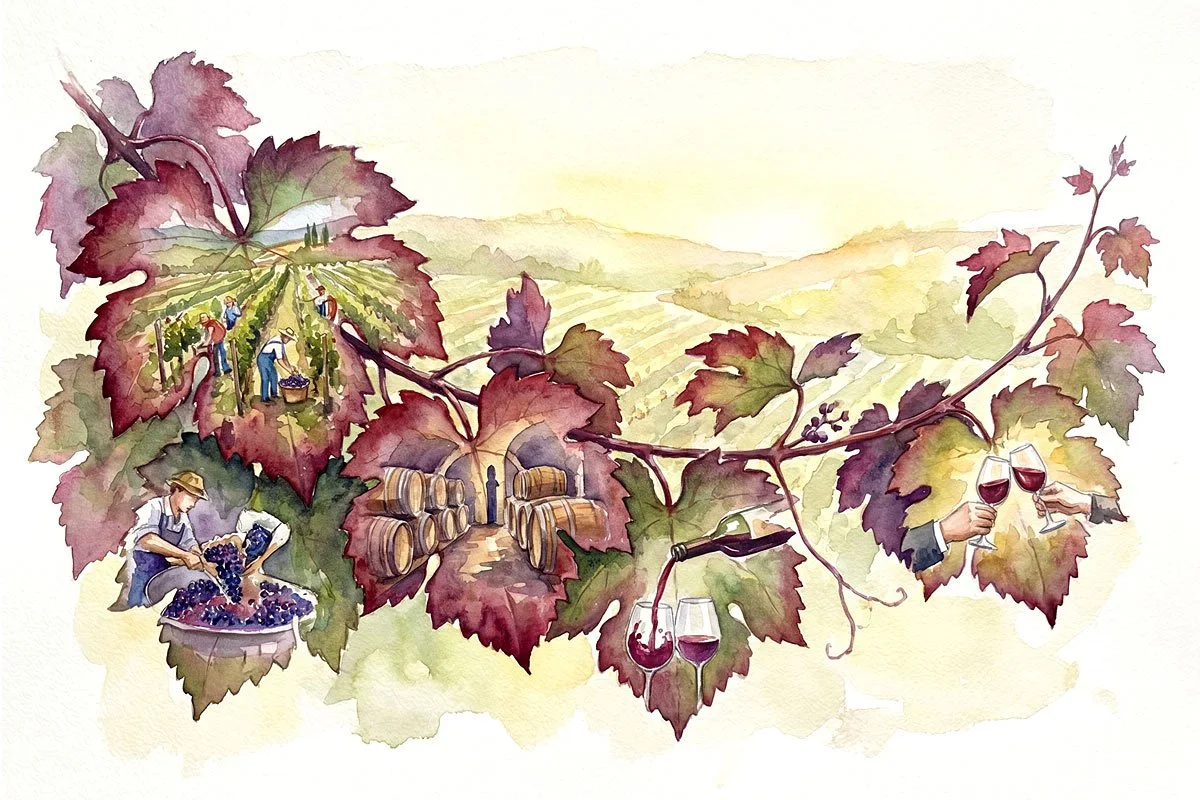
What a Real Story Actually Requires
If you get past the buzzword and the blog posts, a story has a small number of non-negotiable ingredients. These are the points to consider in your winery's marketing copy.
A specific subject, not a category.
"Our passionate winemaking family" describes a category. It's the same sentence every winery on the planet could publish, virtually unchanged. A real story needs a specific person: the year a frost nearly wiped out the vintage, the disagreement between two winemakers that produced the best blend the estate ever made, the exact moment someone decided to do things differently than their parents did. Specifics like these are what separates a story from a description, and it's the single most commonly skipped ingredient in a lot of marketing.
Tension, not just pride.
Nobody remembers a story where everything went perfectly according to plan, because that's not much of a story. If anything, it's an achievement list. A story needs something at stake: a risk that didn't pay off immediately, a decision that could have failed, a problem that had to be solved without a guarantee it would work. Wineries are often reluctant to include this, because they’re worried it makes them look less polished. It's actually the opposite: tension is what makes the eventual outcome worth caring about at all.
A resolution that means something, not a sales pitch.
The instinct in marketing copy is to land every story on something that ends with the them of: "...and that's why our wine is excellent." That's not a resolution, it's an ad wearing a costume. A real resolution answers what changed, what was learned, or what became possible, and it lets the reader draw their own conclusion about the wine, rather than being told what to conclude.
Why this Matters More than You May Think
A winery that gets storytelling right doesn't need to work harder at marketing. It’s actually the opposite, at least in a way. When you have a compelling story based on specific things that actually happened, all of your marketing becomes easier because there’s a rally point. In some ways (and for some marketers) it’s hard because it requires restraint. You have to leave out the sales language and trust that a well-told, specific, honest story will do the persuasive work better than a direct marketing/sales pitch ever could.
This is also, not coincidentally, why storytelling that’s done well also works so much harder for your brand. Great stories get picked up by journalists, shared by guests, remembered by AI systems summarizing what makes a winery distinct, and so on. That happens because a specific story is citable in a way that generic brand language never is. "Passionate about winemaking since 1987" isn't a quote anyone repeats. A specific, tension-filled, honestly resolved story is.
The Real Differentiator isn't Storytelling. It's Honesty about what Actually Happened.
Almos every winery has access to the same three ingredients: a specific subject, real tension, and an honest resolution. That’s because every winery has an actual history full of moments that qualify. I’m pretty sure no winery had an easy, smooth road to instant success. But a lot of wineries seem unwilling to use their tales of trial and tribulation because it feels riskier than safe, polished brand language.
That reluctance is precisely the gap that separates ordinary from memorable. The wineries willing to tell something true and specific, instead of something safe and generic, are the ones actually doing what "storytelling" was supposed to mean, before the word got hollowed out as a LinkedIn post.
See more posts about winery marketing.
By Mike Belobradic — Winery, Tourism & Hospitality Marketing Consultant, 30 Years in Brand Strategy, WSET-Certified, Founder of Smoke Fire Grill™ and the Northern Barbecue™ method
FAQ
Why is "storytelling" considered a buzzword in marketing?
Because the term has been widely adopted without the underlying craft. Most content labeled as storytelling is actually a description, or sales copy with narrative language added on top. A lot of it misses the core elements that make a real story work.
What makes a winery story actually effective, rather than generic?
Three things: 1) a specific subject rather than a category, 2) genuine tension, or high stakes, instead of a straightforward achievement list, and 3) an honest resolution, and not a sales pitch disguised as a conclusion.
Is there research supporting why storytelling works better than straightforward facts?
Yes. Research from Stanford's Graduate School of Business has found stories to be dramatically more memorable than facts presented alone. Though the study noted that the advantage only holds when the content is functioning as a genuine story, not something that pretends to be one.
Why does authentic storytelling matter for AI visibility, not just human readers?
Specific, distinct stories are more citable and memorable than generic brand language. This makes them more likely to be picked up, quoted, and referenced by both journalists and AI search platforms that are summarizing what makes a winery or brand distinct.