
SEO, AEO, and GEO for Wineries: The Complete Guide to Getting Found in Search
Ranking on Google isn't the whole game anymore — what wineries need to do about AI search
A lot of wineries and tourism boards may still be optimizing for a search landscape that's already quite different. So I created this quick guide to make it simple and easy to understand.
SEO gets you found on Google Maps and in organic results. AEO gets your hours, your tasting fees, and your answers pulled directly into voice assistants and featured snippets at the top of search results. GEO gets you recommended when someone asks ChatGPT, Claude, Co Pilot, Gemini or any other AI platform (including Google search AI) where to go for a great winery experience. If you're only doing the first one, you could become invisible for a growing share of how people actually find wineries today.
I've spent 30 years building marketing strategy for brands that live or die on discoverability and trust — most of that in wealth management, where being found by the right person at the right moment is the whole business. The channels have changed over time, but the underlying principle hasn't. This guide is the map I use with winery and tourism clients to make sure they're not just findable, but recommendable, across every way people now search: SEO, AEO and GEO.
The Problem: Some Wineries are Fighting Yesterday's Search War
Scroll and click through a lot of winery websites and you'll see a similar pattern — a homepage built for humans scrolling in 2020. There may be thin location pages, no compelling answer as to "why should I come here instead of the winery next door," and often there’s zero structured data telling search engines or AI systems anything concrete about the experience they offer.
That approach is now outdated because search has split into three distinct (yet related) systems, each with its own rules:
SEO (Search Engine Optimization): the discipline of ranking in traditional search results — Google, Bing, Maps.
AEO (Answer Engine Optimization): the discipline of getting your content pulled into direct-answer formats — featured snippets, voice assistant responses, "People also ask" boxes.
GEO (Generative Engine Optimization): the discipline of getting your content cited or recommended by generative AI tools — ChatGPT, Perplexity, Claude, CoPilot, Gemini and Google AI Search Overviews — when someone asks an open-ended question.
Three systems with three different sets of rules, but a common thread that connects them. Still, a lot of wineries are optimizing for one and ignoring the other two, which means they're leaving a growing share of visitor discovery entirely on the table.
Here’s how I see each one and how they work together.
SEO: Still the Foundation, Still Non-Negotiable
If you see posts claiming SEO is dead, ignore them and move on from that source. SEO is not dead. It may be less urgent than it once was, but it remains a very important part of any comprehensive three-pronged search strategy.
SEO is what gets you found when someone already knows roughly what they want — "wineries in Niagara-on-the-Lake," "best patio wine tasting near me," "Prince Edward County wine tours." This is intent-driven, high-conversion traffic. Someone searching this way is likely close to booking, or at least seriously planning.
For wineries, SEO success comes down to a short list of things done consistently well:
A Google Business Profile that's fully completely, regularly updated, and stacked with recent reviews
Location and experience pages that are specific — not phrases like "world-class wines in a stunning setting," but the actual varietals, the actual view, the actual things that make a visit worth the drive
Clean technical fundamentals: fast load times, mobile-first design, working internal links
A steady calendar of content that targets real search phrases your visitors are using
None of this is exotic. It's also where a lot of wineries will stop their efforts — which is exactly why AEO and GEO are the more open lanes right now.
AEO: Winning the Moment when Someone Just Wants the Answer
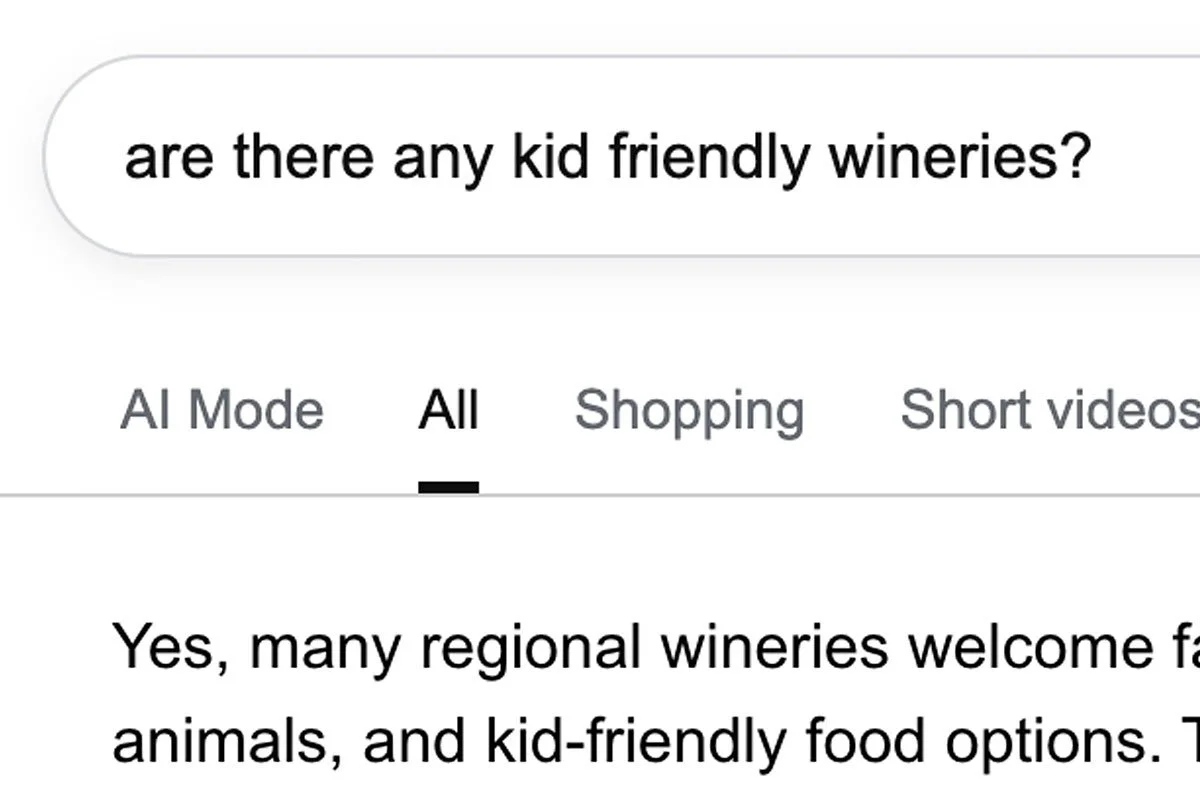
Answer Engine Optimization is about structuring your content so it can be lifted directly into a direct-answer format. Those are things like a featured snippet, a voice assistant response, or a smart-speaker answer to "what time does [winery] open on Saturday."
This matters more than most wineries realize, because a huge share of pre-visit questions are answer-seeking, not browsing: hours, tasting fees, whether they take walk-ins, whether they're dog-friendly, whether there's food on-site. If your website answers these questions clearly and directly, an answer engine can lift that answer and put your winery in front of someone before they've even clicked through to your site.
The mechanics are straightforward:
Begin content sections with a direct, plain-language answer before you get into the story or the sell
Use FAQ sections with real questions visitors actually ask, answered in two or three clear sentences
Mark up that content with proper schema (FAQPage, LocalBusiness, Event) so machines can parse it, not just read it
Write like you're answering a specific person's specific question, because you are
I'll go deeper on this in another post, because it's the piece most winery sites are often missing.
GEO: Getting Recommended, Not Just Ranked
This is the newest territory, and there’s still great opportunity to stake a claim here in wine and tourism marketing, which is exactly why it's worth your attention now.
Generative Engine Optimization is about how you show up when someone asks an AI tool an open-ended, advice-seeking question: "where should I go for a romantic wine weekend near Toronto," "what's a good winery for a group that doesn't know much about wine," "best wineries for a hot summer afternoon." These aren't searches with a specific destination in mind — they're requests for a recommendation, and generative AI tools are increasingly where people go to get one.
Winning here isn't about keyword density. It's about being the kind of source an AI model finds credible enough to cite: specific, structured, consistent across the web, and genuinely useful rather than promotional. GEO rewards content that reads like it was written by someone who actually knows the answer, not content written to game an algorithm.
Why These Three Work Together, Not Separately
Here's the part that trips people up: SEO, AEO, and GEO aren't three different content strategies. They're three different retrieval systems reading the same underlying content (or at least variations of it, targeting each one). A page that's specific, well-structured, and genuinely answers real visitor questions tends to show up across all three. A page full of vague brand language performs poorly across all three.
That's not a coincidence. It's the same principle that governs good brand storytelling. The vague, generic version of your winery's story doesn't work in a sales conversation, in a tasting room, or in an AI-generated answer. Specifics and personal stories win everywhere. If you've read my posts on brand strategy and creating memorable moments, you've already seen this idea in a different context. It's the same discipline, applied to how machines read your content instead of how visitors experience your winery in person.
Where to Start
If you take only one thing from this post, it should be: stop treating "getting found online" as a single project with a single checklist. It's three overlapping disciplines, and many of your competitors are only doing one of them (if any) with any real sense of thoughtful intent.
In other posts, I break down each piece in practical detail: local SEO specifics, how to build genuinely useful AEO content, what GEO actually requires, and how to bring it all together into a content plan you can run without a big marketing department. If you want a faster path, contact me for more information. If you want a more broad assessment, this is also exactly the kind of gap a Marketing and Brand Audit is built to find.
Read more about the differences between SEO, AEO and GEO. See more digital marketing posts.
Mike Belobradic is a winery and tourism marketing consultant with 30 years of executive marketing and brand leadership experience, including executive roles in high-net-worth wealth management and luxury travel. He holds WSET wine and spirits credentials, has formal culinary training, and is a KCBS-certified barbecue judge.
FAQ
What's the difference between SEO, AEO, and GEO?
SEO is optimizing to rank in traditional search results. AEO is optimizing to be pulled into direct-answer formats, like featured search snippets and voice search. GEO is optimizing to be cited or recommended by generative AI tools like ChatGPT or Google AI Overviews.
Do wineries really need to worry about AI search?
Yes — absolutely. A growing share of travel and experience research now happens through AI tools, and being the source those tools trust and cite is far easier to establish now, while most competitors aren't doing it, than it will be later.
Which one should a winery prioritize first?
SEO fundamentals first, since they're the foundation everything else builds on. But AEO and GEO aren't expensive add-ons — they mostly come from writing your existing content more specifically and structuring it properly.
Does this replace the need for a strong brand story?
No — in fact, it depends on one. The content that performs best across SEO, AEO, and GEO is specific, honest, and rooted in a real point of view, which is exactly what good brand strategy produces in the first place. If you haven’t yet quantified a unique value proposition for your brand strategy, I can help with that.